

In May 2025, Casago completed its acquisition of Vacasa for approximately $130 million, a figure that represented a roughly 97% decline from the $4.5 billion peak valuation Vacasa commanded at its 2021 public market debut. The combined entity now manages more than 43,000 properties across 400+ markets in the United States and internationally, including Belize, Costa Rica, and the Caribbean.
That acquisition also set in motion a significant operational shift. Casago is transitioning Vacasa's historically centralized management model to a locally owned franchise structure. In practical terms, many of the local markets that Vacasa operated directly will eventually be sold to new franchise operators. Some of those operators will be experienced local professionals; others may be new to short-term rental management in those specific destinations.
For current Vacasa homeowners, that raises legitimate questions: Who will actually manage my property once the franchise transition reaches my market? Will service quality hold? Is this a good time to evaluate alternatives?
This page addresses those questions directly. It is written by Portoro, which means we have a perspective. But we will give you the full picture, including where Vacasa and Casago have genuine strengths, and where the honest gaps are.
What Changed When Casago Acquired Vacasa
The deal closed May 1, 2025. Casago paid approximately $130 million for Vacasa, a company that had been valued at $4.5 billion when it went public in late 2021. That 97% valuation decline reflects a difficult period for Vacasa: the company faced revenue headwinds, management turnover, and sustained pressure from both homeowners and investors over service consistency and fee complexity.
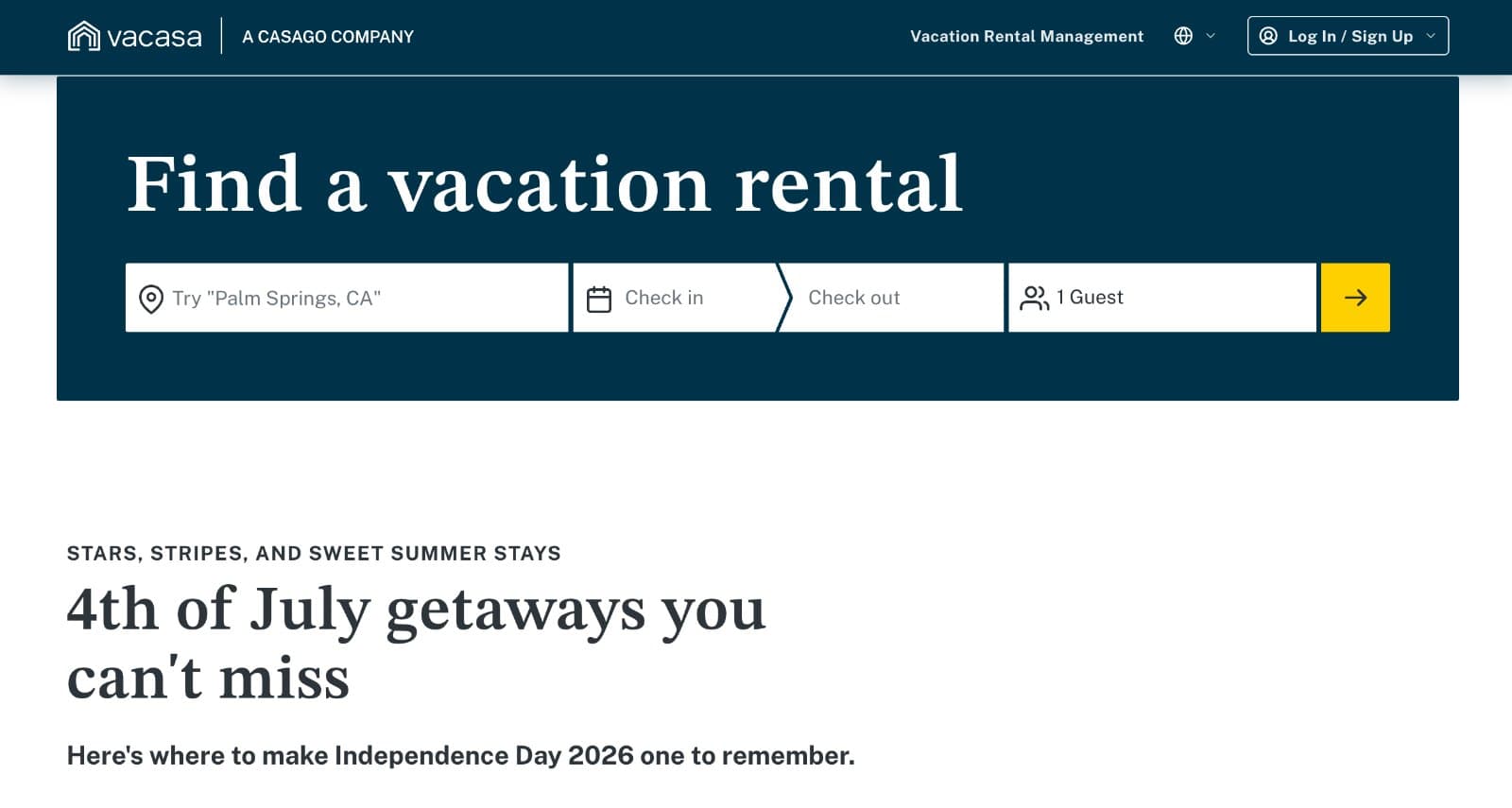
Casago, the acquiring company, operates a franchise-based model with a stated philosophy of being "locally rooted." Its CEO, Steve Schwab, has 25 years of experience in the vacation rental industry. Casago's track record includes a network in which 95% of US local operating partners hold Airbnb Superhost or VRBO Premier Partner status. Roofstock, a proptech company focused on single-family rental investing, participated as a partner in the transaction.
The transition plan: Casago is converting Vacasa's centralized local operations into franchises, then selling those franchises to new operators. In some markets, that will mean a continuity of existing local talent. In others, it will mean an entirely new management team taking over properties they have never managed before.
The upside of Casago's franchise model is real. Locally owned operations tend to be more accountable and more attuned to their specific markets than a centralized national operation. The uncertainty is also real: the franchise transition is still in progress, and the quality of the incoming operator in any given market is not yet determinable. Homeowners in mid-transition markets are, for now, in a period of change.
The Vacasa brand remains consumer-facing under Casago ownership, so guests booking through Vacasa's channels will not immediately notice the structural shift. Homeowners, however, will feel it.
Portoro vs. Vacasa (Casago): Side-by-Side
Here is how Portoro compares to Vacasa (now operating under Casago) across the factors that matter most to property owners.
| Factor | Portoro | Vacasa (Casago) |
|---|---|---|
| Properties managed | 360+ (select portfolio) | ~43,000 |
| Markets | 7 select US mountain & coastal destinations | 400+ US markets + international |
| Service model | Full-service, premium, boutique-scale | Full-service, national scale |
| Fee structure | Custom proposal per property | 25-35% historically; post-merger rates vary by franchise |
| Guest ratings | Airbnb 4.9 / VRBO 4.9 / Google 4.5 | Not publicly published at portfolio level |
| Property inspection protocol | T.R.I.P. Guarantee (3-stage, every stay) | Local teams; protocol varies by market |
| Owner damage protection | Guesty Shield: up to $25K/stay, $1M liability, no security deposit | Guestworks damage program available; terms vary |
| Pricing technology | Wheelhouse dynamic pricing | Proprietary rate tech |
| Local accountability | Named GM per market | Franchise operator (post-merger; varies by market) |
| Revenue performance | 33% avg portfolio growth (2026) | Not publicly published |
| Best for | Premium homes in 7 select leisure destinations | Hands-off owners in mainstream US markets wanting national brand coverage |
Why Owners Leave Vacasa
The reasons homeowners have historically moved away from Vacasa fall into three documented patterns. The Casago acquisition adds a fourth consideration. These are not editorial attacks; they are the patterns most frequently cited by departing Vacasa homeowners and reflected in the public record.
1. Fee complexity
Vacasa's historical fees ran 25-35% of gross revenue, with additional charges for services that many regional managers include in their base rate. Cleaning fees, maintenance coordination, and other line items were sometimes billed above the stated commission. Post-merger, Casago is working to simplify fee structures across its franchise network, but rates will vary by operator and market and are still being defined in many areas. Before signing or renewing any management contract, current or prospective Vacasa homeowners should request a complete written fee breakdown, itemizing every potential charge beyond the base commission.
2. Scale versus attention
Managing 43,000 properties across 400+ markets is an enormous operational undertaking. At that scale, individualized attention per property is structurally difficult. Owners in smaller or less-trafficked markets have consistently reported less responsiveness, higher turnover among local contacts, and management teams that are less familiar with the specific nuances of the destination. This is not unique to Vacasa; it is a structural challenge that affects any national-scale operator.
3. Franchise transition uncertainty
Casago's conversion of Vacasa's centralized markets to independently owned franchises introduces a period of operational change that is not yet complete. Owners in affected markets may experience a change in their local management team. The quality and familiarity of the incoming franchise operator with a specific market, its regulations, its vendors, and its guest expectations is not uniformly determinable. Some transitions will be smooth; others will not. Owners who value stability should be asking, specifically, what the franchise transition timeline looks like in their market.
What Portoro Offers Vacasa Owners Who Are Evaluating Options
If you are a Vacasa homeowner evaluating a switch, here is what changes when you move to Portoro, described as plainly as possible.
First, a note on fit: Portoro operates in seven markets. If your property is not in St. Augustine FL, Destin or 30A FL, the Catskills NY, the Oregon Coast OR, Port Aransas TX, Woodstock or Quechee VT, or Cape Charles VA, this page will not solve your problem. We would rather say that directly than waste your time.
For owners in those seven markets, here is what is different:
The T.R.I.P. Guarantee. Every stay includes a pre-arrival and post-stay inspection, photo-verified cleaning compliance, Field Operations audits, CDC-aligned housekeeping standards, and oversight by a dedicated Area Manager in each market. This is not a general promise about quality; it is a documented protocol with a defined name and a public page describing exactly what it covers.
Guesty Shield owner protection. Every Portoro property is covered for up to $25,000 in damage per stay, with $1 million in liability coverage, guest ID verification and background checks, and no security deposits required from guests. Claims are typically settled within approximately three days. The coverage terms are published, not buried in a franchise agreement.
Revenue track record. Portoro homeowners have seen 33% average portfolio revenue growth as of 2026, driven by Wheelhouse dynamic pricing and distribution across Airbnb, VRBO, and direct channels. Portoro holds a Comparent Market Leader designation, Winter 2026.
Scale that lets you be seen. 360+ managed properties means your home is not one of 43,000. The operational team knows the properties in the portfolio. The local GM knows yours.
Additional inclusions: a real-time owner portal with actual performance data (not quarterly summaries), STR permit and compliance support in every market, and a custom fee proposal for your specific property. The fee structure is not a published rate card; it reflects the characteristics of your home and its market.
What Portoro Owners Say
The most useful signal about any property manager is not the manager's own marketing copy. It is what existing owners say after they have been through a full season.
Andrew Colarusso, a Catskills homeowner, switched to Portoro from a previous manager and was looking specifically for an operator who would follow through on what they committed to:
"They will be rock solid at executing on their commitments."
Andrew Colarusso, Catskills homeownerAndrew also reclaimed roughly 40 hours per month he had previously spent managing issues himself, time he now does not need to spend.
Allison, another Catskills homeowner, describes the scope of coverage:
"Portoro will take care of every aspect of your home and guest management."
Allison, Catskills homeownerAn anonymous owner in Destin describes the experience of working with the local GM directly:
"Call Sarah and she will take care of you!"
Anonymous, Destin homeownerThat Destin owner also reclaimed approximately 40 hours per month and scored Portoro 10 out of 10 across all evaluation categories.
Questions to Ask Before Switching Managers
These questions apply to any management company you are evaluating, including Portoro. If a prospective manager cannot answer all of them clearly and in writing, that is relevant information.
1. Who specifically will manage my property locally, and how long have they worked in this market?
At Portoro, each market has a named General Manager with established relationships with local vendors, inspectors, and permit offices. In the Catskills, that is Amanda Angelo. In Destin, that is Sarah. Ask any manager to give you a name and a tenure.
2. What does the fee include?
Get a written itemized breakdown. This is especially important when evaluating a franchise operation where fee structures may vary by market. Portoro provides a custom fee proposal per property, covering what is and is not included.
3. What is the inspection protocol, specifically: how many inspections per stay, and how are they documented?
Portoro's T.R.I.P. Guarantee covers a pre-arrival and post-stay inspection every stay, with photo-verified cleaning compliance and Field Operations audits. Ask any manager to describe their protocol in writing, not in general terms.
4. What happens if a guest causes damage? Who handles the claim and how long does it take?
Portoro's Guesty Shield covers up to $25,000 per stay with a typical claim resolution of approximately three days. Ask any prospective manager for their coverage ceiling, their claims process, and their average resolution time.
5. Can I see a sample owner report and a portal walkthrough?
Portoro provides a real-time owner portal with booking data, revenue reporting, and maintenance logs. Any manager who cannot show you a live demo or sample report may be providing less transparency than you need.
6. What are the exit terms if I am not satisfied?
Understand the notice period, any penalties, and what happens to future bookings already on the calendar before you sign.
7. Do you handle STR permit compliance and renewals?
Short-term rental regulations have tightened significantly in most leisure markets. Portoro includes STR permit and compliance support in every market it serves. Not all managers do.
Frequently Asked Questions
Is Portoro a good Vacasa alternative?
For owners in Portoro's seven markets (St. Augustine FL, Destin and 30A FL, Catskills NY, Oregon Coast OR, Port Aransas TX, Woodstock and Quechee VT, and Cape Charles VA), yes. Portoro offers boutique-scale attention, a documented property protection protocol in the T.R.I.P. Guarantee, and a 33% average portfolio revenue growth track record as of 2026. For owners outside those seven markets, other alternatives may be a better fit, and we would rather say that clearly than suggest otherwise.
What happened to Vacasa?
Vacasa was acquired by Casago in May 2025 for approximately $130 million, a decline of roughly 97% from its $4.5 billion peak valuation in 2021. The combined entity now manages over 43,000 properties. Casago is transitioning Vacasa's centralized operations to a locally owned franchise model, with the Vacasa brand remaining consumer-facing. The transition is still in progress as of 2026.
How much does Vacasa charge?
Vacasa has historically charged 25-35% of gross rental revenue, with additional fees for services that were sometimes billed above the stated base commission. Post-merger rates under Casago are being restructured and will vary by franchise market and operator. Always request a complete written breakdown, including every potential add-on, before signing any management agreement.
How does Portoro's revenue performance compare to Vacasa's?
Portoro homeowners have seen 33% average portfolio revenue growth as of 2026. Vacasa does not publicly publish comparable portfolio-level revenue performance data. That makes a direct numerical comparison impossible, but it is also itself relevant information when evaluating transparency.
Can I leave Vacasa for Portoro?
If your property is in one of Portoro's seven markets, yes. Review your current management contract carefully before making any contact, specifically the notice period required for termination, any penalties for early exit, and what happens to bookings already confirmed on the calendar. Portoro's local team can walk you through the onboarding process once you have reviewed your current agreement.
Ready to Evaluate Your Options?
If you are a Vacasa homeowner evaluating your next step, the most useful action you can take right now is to clarify three things: who specifically will manage your property after the franchise transition reaches your market, what your current contract's exit terms are, and what any prospective new manager's documented protocols actually include.
If your property is in one of Portoro's seven markets, enter your address below for a free revenue projection and a direct conversation with the local General Manager in your area.
- Casago / Vacasa acquisition details: https://www.vacasa.com
- Portoro T.R.I.P. Guarantee: https://portoro.com/triple-rental-inspection-protection
- Portoro property management services: https://portoro.com